Isolated End-to-End Testing System
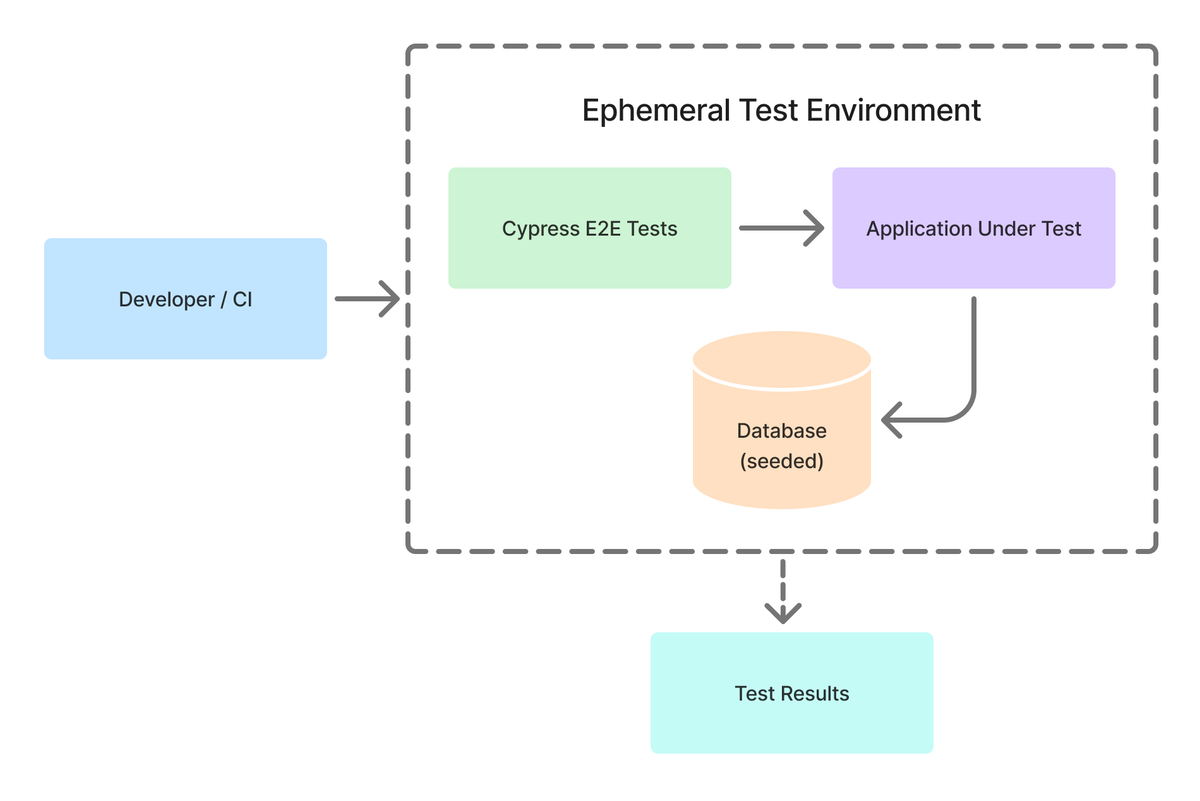
An isolated end-to-end testing setup ensures the entire application stack starts from a clean slate, executes real user flows, and tears everything down after completion. This approach gives reliable, repeatable test results without relying on shared environments or flaky configurations. It moves E2E testing from something teams treat as optional to something they can trust every run.
Problem
Before this system, E2E tests were unreliable and difficult to trust:
- Tests ran against shared or inconsistent environments
- Database state varied between runs
- Failures were non-deterministic and hard to reproduce
- Developers avoided running E2E tests locally
- CI failures required rerunning rather than fixing
This meant regressions often slipped through, and teams treated E2E tests as an unreliable indicator of correctness.
Solution
Instead of focusing on tooling alone, I treated environment isolation as the core of the problem.
The testing system I built does the following:
- Uses Docker Compose to provision the full stack (frontend, backend, database) in an isolated environment
- Seeds the database to a known state before each run
- Executes realistic user flows using Cypress
- Runs the same way locally and in CI without special configuration
- Tears everything down after tests complete, leaving no shared state
This created a disposable, predictable test lifecycle with no manual setup.
Outcome
The new setup changed how E2E testing was used and trusted:
- Flaky failures were eliminated
Failures reliably indicated real regressions rather than environment noise. - CI became more reliable
Test runs were repeatable and diagnosable, reducing reruns. - Developers ran tests locally
Because setup was predictable and disposable, developers used E2E tests as part of their workflow. - Regression detection moved earlier
Problems were caught before deploy instead of in staging or production validation.
Teams moved faster not because tests ran quicker, but because they could trust the results.
Visuals